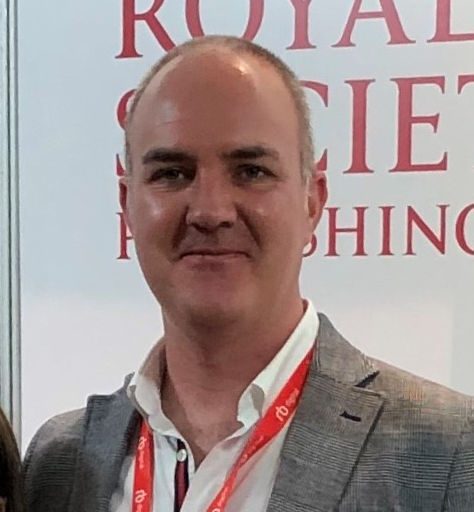
From launching our first open access journal to becoming fully open access has taken 20 years. Graham Anderson, Head of Sales & Marketing, provides an update on the Royal Society journals’ sustainable, long-term move towards open access.

As the UK’s national academy of science, the Royal Society supports open access and open science to maximise the dissemination and re-use of research outputs. In 2021 Royal Society Publishing committed to the ambitious goal of becoming 100% open access by 2026. In the same year, we introduced Read & Publish agreements which helped bring our open access output up from 45% in 2020 to over 70% by the end of 2025. Introducing Subscribe to Open (S2O) has enabled us to achieve our 100% open access target by converting our subscription journals to open access for 2026. This means that there are no charges for readers and researchers can publish open access in the Royal Society’s eight S2O journals without having to pay an article processing charge (APC).
A look back at 2025
Looking back on the Royal Society journals’ progress over 2025, I am pleased to report that we maintained open access output at over 70% across the research journals, and that helped to form the basis for the move to full open access for 2026 under S2O.
We reached more than 675 institutions through our Read & Publish agreements, including the signing of an important agreement with the CAPES consortium in Brazil. We also worked with more than 50 institutions through our Open Access Membership agreements, helping member institutions support their researchers with discounted APCs. In parallel, we continued to support researchers in low- and middle-income countries through our RSOAE scheme, and we strengthened engagement through a range of outreach activities.
Across the journals, we published research from leading scholars in all areas of science. The most popular papers from 2025 were featured on our blog, and we also showcased important research from the Global South in a dedicated issue. As we marked our 360th anniversary of publishing, we were also preparing for the transition to full open access. In many ways, 2025 was a year of both achievement and momentum.
The groundwork for S2O began in 2025, alongside our Read & Publish programme. S2O has been strongly supported by the vast majority of libraries, reflecting shared values around access, sustainability and the future of scholarly communication.

Journals continue to evolve and respond to market demands
I have been with the Royal Society for ten years, and in that time the open access movement has advanced significantly, particularly in recent years. From launching our first open access journal to becoming fully open access has taken 20 years.
Speaking with librarians throughout 2025, I was reminded that, even amid major changes in publishing, discoverability and strong metadata remain fundamental to libraries and to the wider access to knowledge.
AI was a major topic at conferences and in conversations across publishing, particularly in relation to research integrity and COUNTER usage statistics. I hope this focus increasingly leads to practical solutions that improve discovery and dissemination.
The year ahead
As we progress through 2026, we remain committed to supporting robust, accessible and impactful research. Now that we are fully open access, thanks to the support of our libraries and other customers, we will monitor and measure the impact of this transition and report on it later in the year. The multi-year agreements already in place for S2O and Read & Publish will support a sustainable, long-term move towards an open access future.
Cover image: ISS orbiting over the end of the Amazon River. Top down view. Planet map and ISS model from NASA